



AI-Powered Site Search: How It Works and Whether Your Store Needs It


A customer types “beige flowers for the living room,” and the store replies: no results. Meanwhile, the catalog has cream roses and sand-colored hydrangeas. The products exist, they’re just named differently, and the search engine compares words, not meaning. The same thing can happen with any other product.
AI-powered search is meant to solve exactly these situations. Below, we explain in plain language how it works, how it differs from regular search, what your implementation options are, and when the investment makes sense.
In short: AI search understands what a query means, not just which words match. In online stores, it works best combined with classic search by product code. Before you implement anything, though, check your search query report and data quality, because often just improving product names and synonyms gives you a quick win.
How is classic search different from AI search?
Classic search checks whether the words in the query appear in the product data. A good search engine of this type can handle typos and word forms. But it has a limitation: it doesn’t know that “couch” and “sofa” mean roughly the same thing unless someone sets that up.
Semantic search turns product descriptions and queries into so-called vectors, numbers that describe meaning. Then it looks for the products closest to the query. That way it understands descriptions nobody ever entered as synonyms. You’ll find a comparison of the approaches in the diagram.

A hybrid setup is usually the safest, especially when selling parts, materials, and wholesale goods. A sales rep or mechanic typing in a part number wants exactly that product, not something similar in meaning. A customer looking for inspiration, on the other hand, expects something completely different.
What can modern site search do?
Not every tool has all of these features, and not every feature is needed. Options on the market include Doofinder, Luigi’s Box, and Algolia. The first two are more like ready-made services, while Algolia is a toolkit that takes more development work. Treat the conversion lift figures on their websites as vendor claims and verify them with your own test.
Why data matters more than the model
AI can’t invent information that isn’t there. If a product is called “Model 2047” and has no description, even a great search engine won’t do much. Language needs attention too: word forms, colloquial names, and mixing languages (in Polish stores, Polish and English terms often appear side by side). That’s why you should test search on your customers’ real queries, not on examples from a sales demo.
In one of our B2B projects selling decorative products, we planned a single field that combines two modes: fast search by name, SKU, and color, and semantic search in natural language. Already at the analysis stage, it turned out to matter whether the system should search Polish and English names, ignore diacritics, and whether a customer who isn’t logged in should see only items available right now. The model alone can’t settle rules like these.
The prestaninja.pl team
What are your implementation options in PrestaShop?
A module with better classic search. A cheap and fast option when the problem is typos and missing suggestions. For many stores, that’s enough to start with.
An external AI service. Products are sent to the vendor’s system, and the results appear in the store’s search box. Check the price at your traffic level, support for your language, how syncing works, and what data leaves your store.
A custom-built solution. It gives you the most control but requires maintenance and solid expertise. It makes sense for an unusual catalog, for example with multiple availability sources or customer-specific pricing.
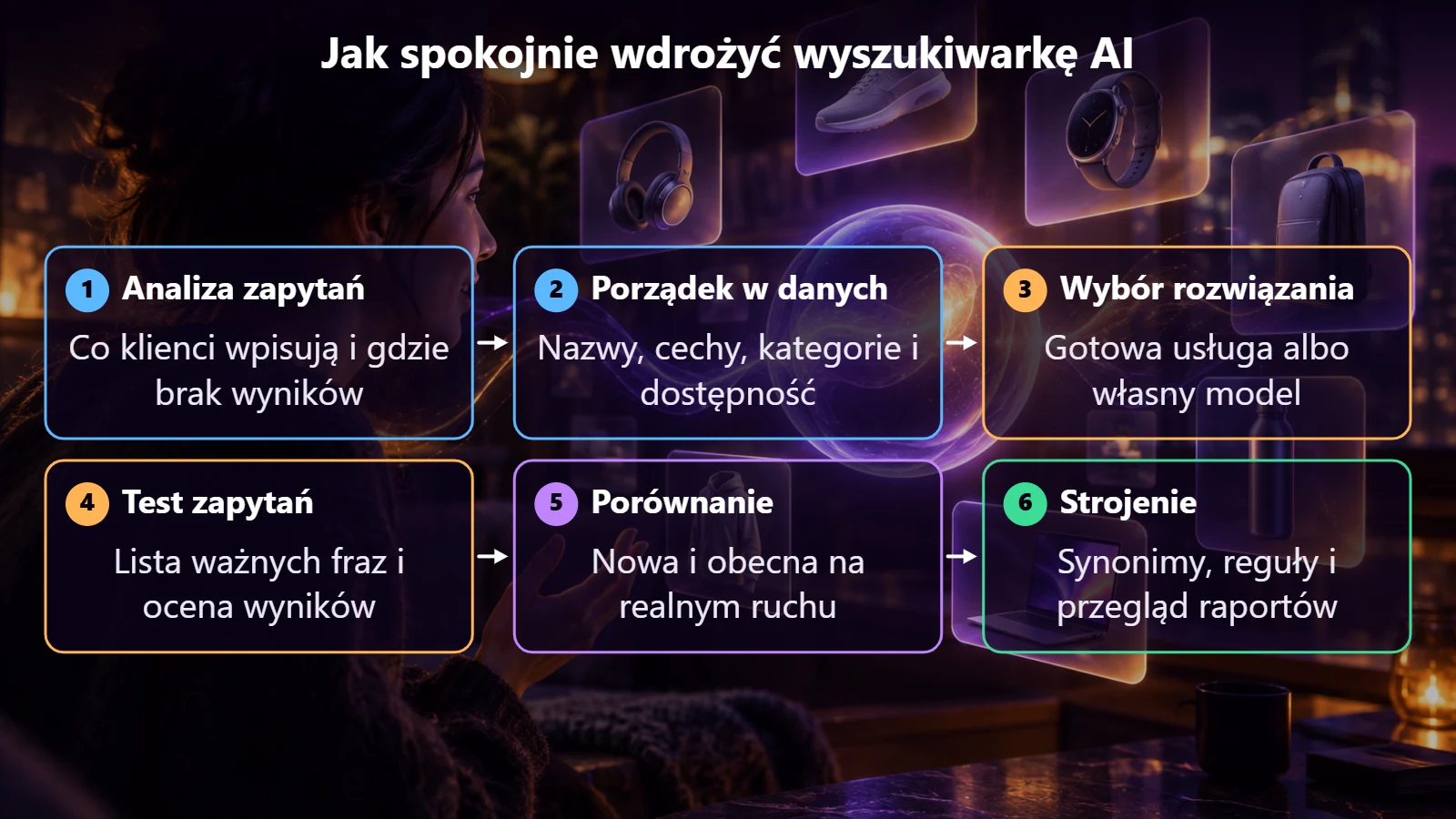
Whichever path you choose, the implementation plan looks similar:
How do you measure whether it’s working?
When don’t you need AI search?
With a few dozen products, good categories and filters usually do more. The same applies when only a small share of customers use search, or when product data is very thin. In that case, fill in descriptions and attributes first. In stores with lots of product codes and professional customers, a fast, well-tuned search by SKU is often enough.
Summary
AI search can make a big difference where customers search descriptively and the catalog is large. The sensible order is: search query report, data cleanup, and only then choosing the technology and testing it on real traffic. That way, you can easily tell whether the monthly cost of the service pays for itself.
If you want to check whether your customers are finding what they’re looking for, get in touch. We’ll analyze your search queries and suggest the simplest solution that fits your store.
FAQ
Does AI search work in languages other than English?
Many solutions claim to support other languages, but quality can vary. Test it on a list of queries from your own store, including different word forms and colloquial terms.
Can it be connected to PrestaShop?
Yes, through the vendor’s module, if they offer one, or a custom-built solution. Check compatibility with your store version.
Will AI replace filters and categories?
No. It complements them. Many customers still like to browse by category, and filters help narrow down results.
Do you have to pay monthly?
External services are usually billed by subscription, often based on the number of products or queries. Ask for a quote at your traffic level.